
How to Improve Your Free Throw in Basketball
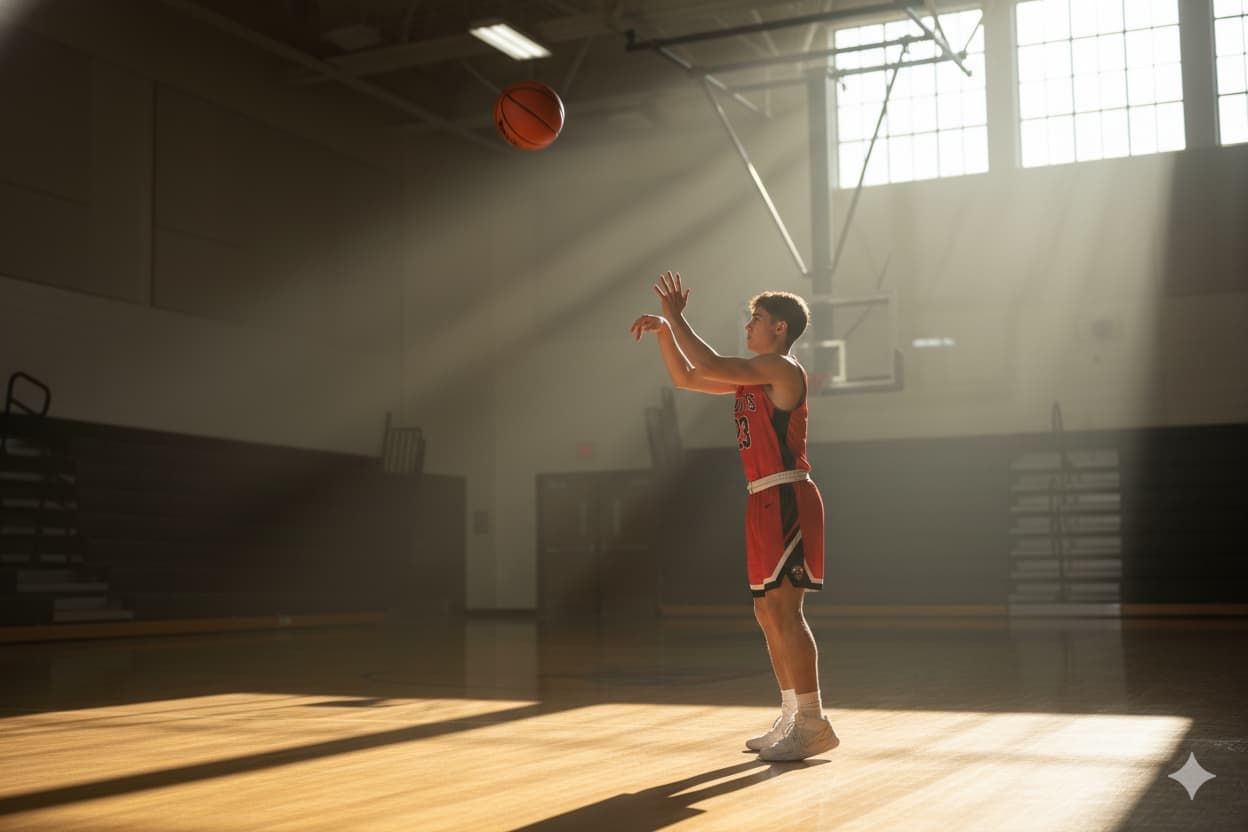
How To Improve Your Free Throw in Basketball
5 techniques + the perfect routine to go from 60% to 80% accuracy
The good news? The free throw is probably the easiest shot to improve in basketball. Why? Because it's the only shot where you control EVERYTHING: no defender, no movement, always the same distance (15 feet). It's a pure repetition shot.
In this guide, we'll break down the 5 pillars of an effective free throw, give you a concrete routine to apply starting tomorrow, and explain why tracking your progress is the key to real improvement.
📊 The Numbers That Matter: Where Do You Stand?
Before talking technique, let's establish benchmarks. Here are the references by level:
| Level | % Made | Reference |
|---|---|---|
| Beginner | < 50% | Priority area to work on |
| Average amateur | 50-65% | Significant room for improvement |
| Good club level | 65-75% | Minimum recommended goal |
| Excellent | 75-85% | NBA Average (~77%) |
| Elite | > 85% | Curry (90.9%), Nash (90.4%) |
💡 Did you know? Stephen Curry made 79 consecutive free throws in 4th quarters and overtimes between 2015 and 2019. That's no accident: it's the result of a perfectly refined routine.
🤔 Why Free Throws Are So Difficult
Paradoxically, it's precisely because it's "simple" that it's difficult. Ray Allen, one of the greatest shooters in history, called the free throw line "the line of frustration." Here's why:
It's an "anti-basketball" shot
Basketball is a sport of rhythm and movement. Every other shot is taken with momentum. Free throws? You're at a complete stop. Your body and mind must adapt to this disruption.
The emotional context
A free throw often comes after a foul, meaning after physical contact. You might be winded, frustrated, or even in pain. You're exposed, alone facing the basket, with the crowd watching.
Too much time to think
Unlike an in-game shot where instinct takes over, at the free throw line you have time to think. And that's when doubts creep in: "What if I miss?", "Everyone's watching me"...
The solution? Transform this shot into an automatic motion through solid technique and a well-practiced routine. That's what we'll cover now.
🎯 The 5 Pillars of an Effective Free Throw
Foot Position and Balance
Everything starts from the ground up. Poor foot position = unbalanced shot = miss.
✅ How to do it
- Feet shoulder-width apart
- Shooting foot (same side as shooting hand) slightly forward
- Toes pointing toward the basket
- Knees slightly bent for power
- Body weight centered, slight forward lean
Ball Grip
Your grip determines the spin and therefore the trajectory of your shot.
✅ How to do it
- Shooting hand under the ball, fingers spread
- Ball seams perpendicular to your fingers
- Guide hand on the side (form a "T" with your thumbs)
- Ball rests on your fingertips, NOT your palm
- Small gap between palm and ball
The Shooting Motion
This is the heart of the mechanics. A fluid motion, from bottom to top.
✅ The sequence
- 1. Bring the ball to your "shot pocket" (in front of your shoulder)
- 2. Elbow bent at 90°, aligned with the basket
- 3. Leg extension (power comes from the legs!)
- 4. Arm extension toward the basket
- 5. Wrist "snap" for backspin
- 6. Follow-through: keep arm extended, hand pointing at the basket
The Aiming Point
Where exactly should you look? There are two schools of thought, and both work.
✅ The options
- Option 1 - Front of the rim: The point closest to you. Most common choice.
- Option 2 - Back of the rim: Gives you margin for error if the shot is slightly long.
The Pre-Shot Routine
This is THE differentiating factor of great shooters. Your routine creates a bridge between the intense activity of the game and the static moment of the free throw.
✅ NBA routine examples
- Stephen Curry: Precise dribbles, adjusts his feet, looks at the basket
- Dirk Nowitzki: "Metronomic" routine with subtle variations
- Richard Hamilton: 1 side dribble before each shot
⏱️ Your Perfect Routine in 6 Steps
Here's a routine you can adopt and customize. The goal: make your free throw an automatic motion.
🔄 The Complete Routine
Stand at the center nail, feet apart, shooting foot slightly forward
One deep breath in, slow exhale to calm your heart rate
Your personal number of dribbles (usually 2 to 5)
Position your hands as described above
Lock onto your aiming point, focus only on it
Fluid extension, follow-through, hold the pose
Important: This routine must be IDENTICAL for every free throw. In games as in practice. Repetition creates automaticity.
💪 Training Program: From 60% to 80%
Repetition is your best friend. Here's a progressive program to significantly improve your percentage.
📅 Daily Training (15-20 min)
- 50 free throws minimum per day
- Always with your complete routine
- Track your results (made/attempted)
Specific Drills
- Sets of 10: Do 5 sets of 10 shots, record each set
- Under pressure: Do 10 push-ups/squats between each set to simulate fatigue
- The "2 in a row" challenge: Don't leave the line until you make 2 consecutive shots
- Game situation: Have a friend try to distract you (noise, movement)
"You should practice free throws every time you train. Ideally, 10-15 minutes before or after each session."
🔑 The Secret of the Best: Track Your Progress
Do you really want to improve? Then you need to MEASURE. What doesn't get measured doesn't get improved.
- You'll see your real progress (not what you imagine)
- You'll identify your patterns (better in the morning? after warm-up?)
- You'll stay motivated by watching the numbers improve
- You can adjust your technique if results plateau
That's exactly why tracking your stats game after game is essential. When you see your percentage go from 62% to 68% then 75%, your confidence at the line grows naturally.
❓ Frequently Asked Questions (FAQ)
How many free throws should I shoot per day to improve?
A minimum of 50 shots per day is recommended to create real automaticity. Pros often shoot 100 to 200. What matters isn't just quantity, but quality: each shot should be taken with your complete routine, just like in a game.
Why am I better in practice than in games?
This is the emotional context problem. In games, you're tired, stressed, exposed. The solution: recreate these conditions in practice (simulated fatigue, teammate pressure, stakes). Your routine must become so automatic that it works even under pressure.
Should I aim at the front or back of the rim?
Both work. The front of the rim is the most common choice because it's the closest point. The back gives you margin if the shot is slightly long. Most important: choose ONE point and always keep it. Consistency beats the choice itself.
Should my routine be long or short?
Short: ideally between 5 and 10 seconds. A routine that's too long gives you time to doubt and may annoy the referee. It should be long enough to recenter you, short enough to stay in the flow.
Does the "granny shot" (underhand) technique really work?
Yes! Rick Barry, the 4th best free throw shooter in NBA history (89.98%), used this technique. It's biomechanically effective because it uses a more natural motion. But it's considered "uncool" today, which explains why no one uses it. If you don't care about that and it works for you... why not?
🚀 Take Action: Your Plan for the Next 30 Days
You now have all the keys to significantly improve your free throw percentage. Here's your concrete action plan:
📋 This Week
- Define YOUR personal routine (position, breathing, dribbles, aim)
- Shoot 50 free throws per day with this routine
- Record your results (made/attempted) every day
In 30 days, you'll see significant improvement. But only if you measure your progress and stay consistent.
🏀 HoopsTrackR — Track Your Free Throws Game After Game
Turn your practice into measurable progress
You might also like
How to Analyze Your Performance After a Basketball Game
Discover the complete method to analyze your performance after every game: the 5 essential questions to ask yourself, the 7 key stats to track, and how to turn your observations into a concrete improvement plan. Inspired by the best players and coaches.
7 Basketball Statistics To Track Your Progress
Discover the 7 essential basketball stats to measure your progress. Complete guide for amateur players with goals by level and practical tips. Start tracking!
How to Set Realistic Basketball Goals
84% of players have no clear goals — and plateau. In this complete guide, discover the SMART method, the 3 goal types (outcome, performance, process), and a 5-step action plan to turn your ambitions into measurable progress. Includes a free template and stat-specific examples.