
How to Handle Pressure in Basketball Games
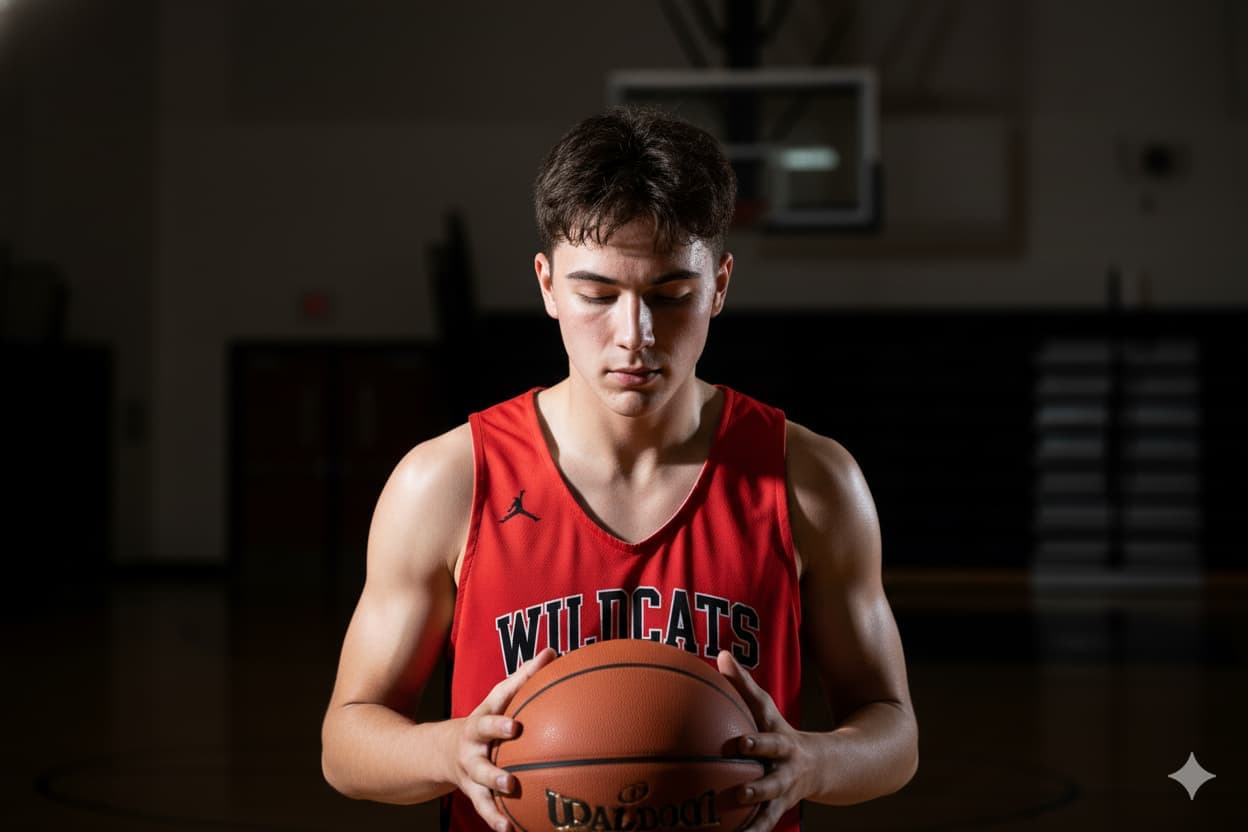
How to Handle Pressure in Basketball Games
7 mental preparation techniques to stay calm and perform when it matters most
Shaky hands before tip-off. Heart pounding at the free-throw line. Feeling like you forgot how to play when the stakes get high. Sound familiar? You're not alone. Even the best NBA players had to learn how to handle pressure in games.
The good news? Your mental game can be trained. Just like your dribble or your shot. And contrary to what you might think, it's not about "character" or natural talent. It's a skill you can develop with the right techniques and a bit of practice.
In this guide, we'll break down what happens in your head when pressure rises, and more importantly, give you 7 concrete tools to turn that stress into fuel. Ready to develop a champion's mindset?
Why You Lose Your Edge Under Pressure
Before we talk solutions, let's take 2 minutes to understand what's really happening in your body and mind when stress kicks in. Spoiler: it's completely normal, and even useful—if you know how to manage it.
Your Body's Stress Response
When you feel pressure, your body triggers an ancient reaction: the "fight or flight" mode. Your sympathetic nervous system activates and sets off a cascade of responses:
- Your heart rate increases to pump more blood to your muscles
- Your breathing becomes faster and shallower
- Your muscles tense up, ready for action
- Adrenaline and cortisol flood your system
- Your vision narrows (tunnel vision)
The problem? This response was perfect for escaping a tiger. Not so great for hitting a clutch free throw. Your body is preparing for a physical threat when you actually need finesse, focus, and motor control.
The Right Amount of Stress Exists
Important: stress isn't your enemy. Sports psychologists talk about "optimal activation level." Think of it like a thermometer:
- Too low (0-3): You're sluggish, unfocused, playing "out of it"
- Optimal zone (4-7): You're alert, focused, reactive—this is where you play your best ball
- Too high (8-10): You lose your edge, your movements become jerky, you make mistakes
💡 The goal isn't to eliminate stress, but to learn to regulate it to stay in your optimal zone.
The Thoughts That Sabotage Your Performance
The real problem often isn't the situation itself, but what you tell yourself about it. These automatic thoughts can tip you over the edge:
- "If I miss, everyone will judge me" → Fear of others' opinions
- "I never come through in these moments" → Self-fulfilling prophecy
- "This is too important, I can't mess up" → Added pressure
- "The opponent is better than me" → Mental defeat before you even play
The good news: You can learn to identify these thoughts and replace them with more helpful ones.
7 Techniques to Handle Pressure in Games
Here's your mental toolkit. Each technique has been tested by elite athletes and validated by sports psychology research. Start by mastering 2-3 of them before integrating all of them.
Controlled Breathing (Heart Coherence)
This is THE foundational technique, used by champions like Michael Phelps and players from FC Barcelona. By controlling your breathing, you send a signal to your nervous system to switch from "alert" mode to "calm" mode. Near-instant effect in 2-3 minutes.
How to do it
- Inhale for 5 seconds through your nose (fill your belly)
- Exhale for 5 seconds through your mouth (slowly)
- Repeat this cycle 6 times per minute for 3-5 minutes
- Focus only on the rhythm of your breath
- If your mind wanders, gently bring it back to your breathing
Positive Visualization
Your brain doesn't really distinguish between an imagined action and a real one. By visualizing yourself succeeding, you "program" your brain for success. Pros use this systematically before competitions.
How to do it
- Find a quiet spot and close your eyes
- Imagine yourself in a game situation (be specific: the court, the crowd, your teammates)
- Visualize yourself executing successfully (shot, pass, defense)
- Add sensory details: the sound of the ball, the smell of the court, the feel of the leather
- Feel the positive emotions: confidence, flow, enjoyment
Physical Anchoring (Reset)
When stress rises, your body tightens up. Anchoring is a technique that lets you physically "reset" in seconds by creating an association between a gesture and a calm state.
How to do it
- Choose a simple, subtle gesture (clench your fist, touch your wrist, adjust your shorts)
- Practice this gesture when you're relaxed and confident (after a good practice, for example)
- Mentally associate this gesture with the feeling of calm and confidence
- During games, use this gesture to instantly "trigger" that state
- Combine with a deep breath to reinforce the effect
Positive Self-Talk
What you say to yourself directly influences your performance. Positive self-talk means replacing automatic negative thoughts with constructive, realistic affirmations.
How to do it
- Identify your recurring negative thoughts ("I'm gonna miss," "I suck")
- Prepare positive but realistic replacement phrases
- Use "you" instead of "I" ("You're ready" rather than "I'm ready")
- Repeat these phrases in your head or under your breath
- Keep simple keywords for high-pressure moments ("Calm," "Strong," "Ready")
Process Focus (Not Outcome)
Pressure often comes from fear of the outcome (win/lose, make/miss). By focusing on the process—the actions you control—you free your mind from the weight of what's at stake.
How to do it
- Identify elements you control: your effort, your focus, your communication
- Break the game into process micro-goals ("be active on defense this possession")
- Forget the score and focus on the NEXT play
- After each play, evaluate your process, not the result
- Mentally celebrate when you execute well, even if the shot doesn't go in
Personalized Pre-Game Routine
A structured routine before every game creates a secure framework that reduces anxiety. It allows you to progressively enter your "bubble" of concentration.
How to do it
- Define the main steps: arrival, preparation, physical warmup, mental preparation
- Include fixed elements: same playlist, same stretches, same timing
- Include 5-10 min of visualization and/or breathing
- Plan a moment to mentally "lock in" (no more distractions)
- Test and adjust until you find what works for YOU
Acceptance and Quick Recovery
Mistakes are part of the game. What separates great players is their ability to move on instantly. This technique teaches you to "flush" mistakes and stay in the present.
How to do it
- Accept that mistakes are inevitable (even pros make them)
- Create a "reset" gesture (clap your hands, adjust your jersey) to symbolize moving on
- Apply the 3-second rule: you have 3 seconds to react emotionally, then you move to the next play
- NEVER dwell on a mistake during the game—analyze it afterward
- Focus on what you can do NOW
Quick Reference: Which Technique for Which Moment?
| Moment | Recommended Techniques | Duration |
|---|---|---|
| Before the game | Pre-game routine, Visualization, Breathing | 15-30 min |
| Warmup | Self-talk, Process focus | Ongoing |
| Timeout | Breathing, Anchoring | 30-60 sec |
| Free throws | Anchoring, Breathing, Process focus | 5-10 sec |
| After a mistake | Acceptance/Recovery, Self-talk | 3 sec max |
| Clutch time | All (as needed) | Instant |
The Secret of Confident Players: Tracking Your Progress
You know what really builds self-confidence? Evidence. Not empty encouragement, not positive thinking without foundation—concrete proof that you're improving.
That's where tracking your performance becomes a mental preparation tool in itself:
- You see in black and white that you're improving → your confidence grows naturally
- You identify your strengths → you know what to rely on in tough moments
- You spot your weaknesses → you work on them and reduce your sources of anxiety
- You measure the impact of your mental prep → you adjust what works
When you step on the court knowing exactly where you stand, with data proving your progress, pressure loses its power. You don't "believe" you're ready anymore—you KNOW it.
Frequently Asked Questions (FAQ)
Does stress completely disappear with these techniques?
No, and that's not the goal. Some stress is necessary to perform—it keeps you alert and mobilizes your resources. The goal is to learn to regulate it so it becomes an ally rather than a hindrance. With practice, you'll learn to recognize your "optimal level" and maintain it.
How long does it take to see results?
Breathing techniques can have an immediate effect from the first use. For other techniques, expect 2-3 weeks of regular practice before seeing a noticeable difference. Like any training, consistency is key. 10 minutes a day is better than one hour a week.
I get stressed even during practice, is that bad?
No, it's actually an opportunity! Practice is the ideal time to work on these techniques in a lower-stakes environment. Use every session to practice breathing, self-talk, and anchoring. When game time comes, these reflexes will be automatic.
How do I know which technique works best for me?
Experiment! Start with breathing (it's the most universal) then test the others one by one. Note in a journal what works for you. Some people are more visual (visualization), others more kinesthetic (anchoring), others need to talk to themselves (self-talk). There's no right answer, only what works for YOU.
Should I consult a professional sports psychologist?
It's not required to get started, but it can be very helpful. A sports psychologist can help you identify your specific blocks, personalize techniques, and accelerate your progress. If you feel that stress is seriously impacting your enjoyment of the game or your daily life, consulting a professional is recommended.
Turn Your Pressure Into Power
You now have 7 concrete tools to handle pressure in games. But remember: knowing these techniques and practicing them are two different things. Your mental game needs work EVERY DAY, not just when you need it.
Start today:
- Choose ONE technique to master this week
- Practice it for 5 minutes every day
- Use it at your next practice
- Note what works and adjust
And to maximize your confidence, combine your mental preparation with rigorous tracking of your progress.
🧠 HoopsTrackR — Build Your Confidence on Evidence
Step on the court with proof of your value
You might also like
How to measure your basketball progression over 12 months
How do you know if you're really improving at basketball over a full year? Baseline, monthly checkpoints, stats that prove progression, handling the plateau.
Point guard: the key stats to track
Which basketball stats really matter for a point guard? A/TO ratio, usage rate, PPG vs APG, FG%… The dedicated guide for the 1 position with NBA and EuroLeague examples.
Basketball match sheet: 10 classic mistakes to avoid
Filling a basketball match sheet without errors is a real skill. The 10 most frequent mistakes, with concrete scenarios and how to avoid them.