
7 Basketball Statistics To Track Your Progress
7 Basketball Statistics To Track Your Progress
The ultimate guide for amateur players who want to level up their game

You train hard several times a week, you play games every weekend, but how do you know if you're really improving? That's where basketball statistics come in. Tracking your stats isn't just for NBA pros — it's the secret of amateur players who progress fast and smart.
In this complete guide, we'll show you exactly which statistics to track to measure your basketball progress, how to interpret them, and most importantly, how to use them to transform your game. Whether you play in a league, recreationally, or on the street, these metrics will become your best allies.
Why Track Your Basketball Statistics?
Before diving into the numbers, let's talk about the "why." Tracking your basketball statistics is much more than an obsession with numbers — it's a proven method for improvement.
The Concrete Benefits of Statistical Tracking
- Identify your strengths and areas for improvement with precision
- Objectively measure your progress over weeks or months
- Set realistic goals based on concrete data
- Stay motivated by visualizing your progress
- Adapt your training based on identified weaknesses
💡 In the NBA, teams employ dedicated statistical analysts. As an amateur player, you can also use this approach — at your scale — to optimize your progress.
The 7 Essential Statistics to Track
Here are the most relevant amateur basketball stats to evaluate and improve your game. We've ranked them from most basic to most advanced.
Field Goal Percentage (FG%)
Field goal percentage is THE fundamental stat. It measures your overall offensive efficiency by counting all your shot attempts in play (both 2-pointers and 3-pointers combined).
(Field Goals Made ÷ Field Goals Attempted) × 100Goals by Level
- Beginner: 35-40%
- Intermediate: 40-45%
- Advanced: 45-50%+
Three-Point Percentage (3P%)
The three-point shot has become essential in modern basketball. Tracking your 3P% lets you evaluate your long-range accuracy.
Benchmarks
- Below 30%: Work needed on shooting mechanics
- 30-35%: Average for amateur players
- 35%+: Excellent, you're a threat from beyond the arc
Free Throw Percentage (FT%)
Free throws reveal your consistency and pressure management. This is often where games are won or lost.
Goals
- Minimum goal: 70%
- Good level: 75-80%
- Excellent: 80%+
Rebounds Per Game (Offensive and Defensive)
Rebounds measure your physical commitment and game reading. Distinguish between offensive rebounds (second chance) and defensive rebounds (rim protection).
What Your Rebounds Reveal
- High offensive rebounds → Excellent timing and aggressiveness
- High defensive rebounds → Good positioning and anticipation
- Off/def ratio → Your playing style (offensive vs defensive)
Assists Per Game
This statistic measures your ability to create opportunities for your teammates. An assist is a pass that leads directly to a basket.
Interpretation
- 1-2 assists/game: Individual player, can improve court vision
- 3-5 assists/game: Good passer, team-oriented vision
- 6+ assists/game: Excellent point guard skills
Turnovers
Turnovers are wasted possessions. The fewer you commit, the more scoring opportunities your team has.
How to Reduce Your Turnovers
- Improve your dribbling under pressure
- Work on your peripheral vision
- Avoid risky passes
- Better protect the ball when driving
Player Efficiency Rating (PER / EVAL)
The efficiency rating is a composite statistic that synthesizes your overall impact on the game. It's widely used in European leagues and provides a complete picture.
Points + Rebounds + Assists + Steals + Blocks - Missed FG - Missed FT - TurnoversStatistics Summary Table
Here's a summary of the 7 statistics with goals to aim for based on your level:
| Statistic | Beginner | Intermediate | Advanced |
|---|---|---|---|
| Field Goal % | 35-40% | 40-45% | 45%+ |
| 3P% | 25-30% | 30-35% | 35%+ |
| FT% | 60-70% | 70-80% | 80%+ |
| Rebounds/game | 2-4 | 5-7 | 8+ |
| Assists/game | 1-2 | 3-5 | 6+ |
| Turnovers | < 5 | < 4 | < 3 |
| AST/TO Ratio | > 1:1 | > 1.5:1 | > 2:1 |
How to Use Your Statistics to Improve
Regular Tracking
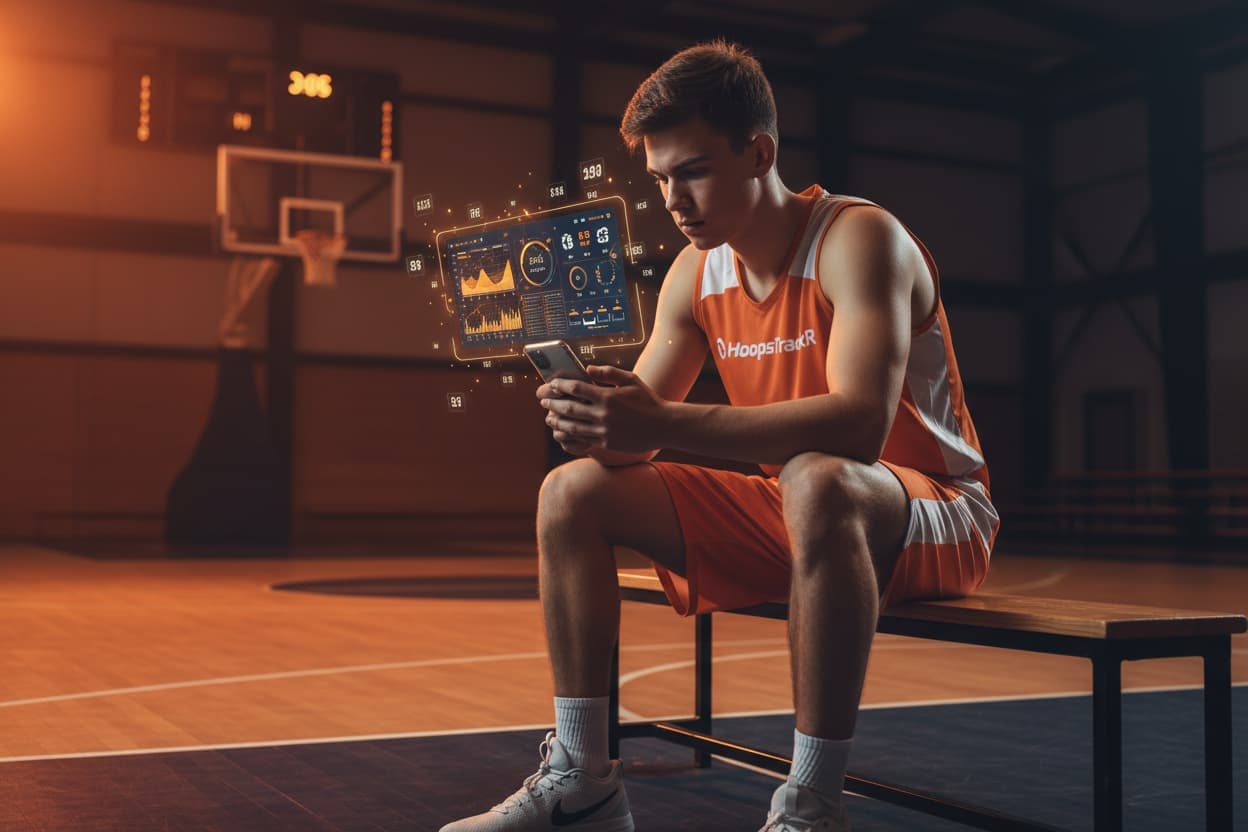
Consistency is key. Record your stats after every game or training session. An app like HoopsTrackR makes it easy to log everything from your smartphone.
Trend Analysis
Don't focus on a single game. Look at your progress over 5 to 10 games minimum. That's where real trends emerge.
Set SMART Goals
Use your stats to define Specific, Measurable, Achievable, Realistic, and Time-bound goals.
What Your Trends Reveal
- Your shooting percentage is steadily rising? Your shot selection is improving.
- Your turnovers are increasing? You might be taking too many risks.
- Your assists are growing? Your court vision is developing.
💡 SMART Goal Example
"Increase my field goal percentage from 38% to 42% over the next 8 weeks by practicing mid-range shots 3 times per week."
Frequently Asked Questions (FAQ)
What is the most important statistic in basketball?
It depends on your position! For a point guard, the assist-to-turnover ratio is crucial. For a power forward, rebounds matter more. However, the Player Efficiency Rating (PER) or overall evaluation remains the most comprehensive indicator of your impact on the game.
How many games does it take to see progress?
Count on about 8 to 12 games to observe reliable trends. Game-to-game variations are normal — it's the curve over several weeks that really matters.
How do I track my stats during a game?
Several options: ask a teammate on the bench, use a tracking app like HoopsTrackR, or note the highlights right after the game while it's fresh. Ideally, have a dedicated tool that automatically calculates percentages and averages.
Are stats really useful for amateur players?
Absolutely! That's actually where they're most useful. Without pro club resources (personal coach, video analysis...), your statistics are your best self-evaluation tool. They help you pinpoint exactly what's working and what needs improvement.
What if my stats aren't improving?
Don't panic! First analyze whether you're working on the right things. A plateau might mean it's time to change your training approach. Sometimes focusing on just one statistic at a time is enough to unlock progress.
Level Up Your Game with HoopsTrackR
You now have all the keys to track your basketball progress like a pro. But let's be honest: manually recording stats after every game is tedious.
You might also like
How to Reduce Basketball Turnovers with Stats Tracking
Every turnover costs about 1 point. Learn to measure your turnovers by type, turnover rate and A/TO ratio to target the real cause.

Offensive rebounding in basketball: score 8 extra points per game from second chances
Teams that crash the glass score 8 extra points per game in second chances. OREB%, 3 core techniques, 4 drills and a 4-week program to become a reliable offensive rebounder.
Improve Your Free Throws: From 60% to 80% in 6 Weeks
The free throw is the only fully controllable shot in basketball. The BEEF method, a pre-shot routine, 4 drills and a 6-week program to go from 60% to 80%.