
How to Analyze Your Performance After a Basketball Game
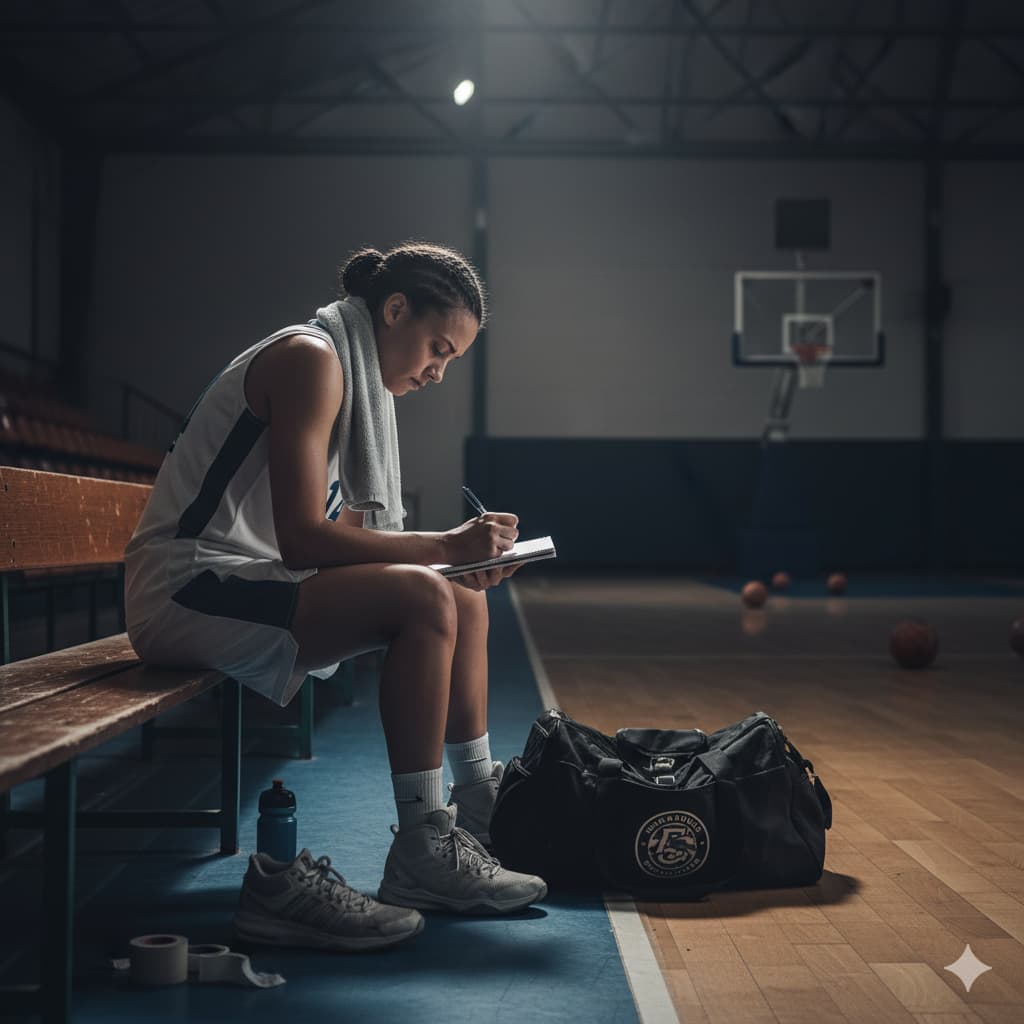
How To Analyze Your Performance After a Basketball Game
The 5-question method to turn every game into a growth opportunity
Post-game reflection is a powerful tool used by all elite athletes. But you don't need to be a pro to adopt it. In this guide, we'll give you a simple, concrete method to analyze your games, identify areas for improvement, and create an action plan that will actually help you progress.
🎯 Why Self-Analysis Changes Everything
Most amateur players make a fundamental mistake: they judge their performance solely on the result (win/loss) or on their feelings ("I felt good"). The problem? Both indicators are misleading.
❌ The 3 Traps of Self-Evaluation
The result trap
You can win while playing poorly (weak opponent, luck) or lose while playing well (superior opponent, bad luck). The score doesn't tell everything about YOUR performance.
The feelings trap
Our feelings are biased by emotions. You might feel "on fire" while shooting 30%, or feel terrible even though you did excellent defensive work.
The selective memory trap
We remember our spectacular plays (the clutch 3-pointer) but forget mistakes (the 3 turnovers right before). Our brain lies to us.
"Self-evaluation allows players to take ownership of their development and identify areas for improvement that coaches might have overlooked."
The solution? A structured method that forces you to look at the facts objectively, not your impressions.
❓ The 5 Questions to Ask Yourself After Every Game
Here are the 5 questions that will transform how you analyze your games. Take 10 minutes after each game to answer them honestly.
"What did I do well today?"
🎯 Why this question
Identifying your strengths is just as important as fixing your weaknesses. What works should be repeated and amplified. Be specific: not "I defended well," but "I cut off driving angles on the left side."
"What didn't work?"
🎯 Why this question
This is the hardest question because it requires honesty. But it's also the most important for growth. Look for patterns: do you always lose the ball in the same situations?
"What could I have done differently?"
🎯 Why this question
This question transforms mistakes into learning. It forces you to imagine alternatives and prepare your response for the next time the situation arises.
"How was my attitude and energy?"
🎯 Why this question
Basketball isn't just technique. Your body language, energy, and communication with teammates influence your performance and the team's.
"What should I focus on at the next practice?"
🎯 Why this question
Analysis without action is pointless. This question forces you to transform your observations into a concrete improvement plan with a clear priority.
📊 The 7 Key Statistics to Track
Qualitative questions are good, but numbers don't lie. Here are the essential stats to record after each game:
| Statistic | What it reveals | Typical goal |
|---|---|---|
| Points | Your direct offensive contribution | Varies by role |
| FG% | Your efficiency (quality > quantity) | > 40% overall, > 33% from 3 |
| Rebounds | Your physical effort and positioning | Depends on size/position |
| Assists | Your court vision and unselfishness | > 2 for non-point guards |
| Turnovers | Your ball protection | < 3 per game |
| Assist/Turnover Ratio | Your efficiency in ball handling | > 2:1 (2 assists per turnover) |
| +/- (differential) | Your overall impact when on the court | Positive = good sign |
💡 Important: Statistics don't tell the whole story. A player can score 0 points but have done excellent defensive work that doesn't show up in stats. Always combine numbers with your qualitative analysis.
📝 The Complete 4-Step Method
Here's how to structure your post-game reflection effectively:
🔄 Your Post-Game Routine
Note your basic stats and 2-3 initial impressions. Don't judge yet, just capture the facts while they're fresh.
Answer the 5 questions with perspective. The emotion has settled, you can be more objective.
Choose ONE area of improvement for your next practice. Just one. Write it down.
Once a month, reread all your notes. Look for patterns: which mistakes recur? What progress is visible?
"Do your post-game reflection the same day, as soon as possible after the game. Use the same questions for every game — it'll help you form a habit. Be honest in your answers."
⚠️ Mistakes to Avoid in Your Analysis
❌ Mistake #1: Being too hard on yourself
Excessive self-criticism is counterproductive. The goal isn't to blame yourself but to learn. If you only find negatives, you're missing half the analysis.
❌ Mistake #2: Staying vague
"I defended poorly" teaches you nothing. "I let my opponent take 3 open shots on screens" gives you a precise area to work on.
❌ Mistake #3: Not writing it down
If you don't write it down, you forget. And if you forget, you repeat the same mistakes. A simple notebook or app is enough.
❌ Mistake #4: Only analyzing losses
Wins also deserve analysis. What worked? How can you replicate it? A win without analysis is a wasted opportunity.
🔑 The Secret: Consistency
A deep analysis from time to time is useless. It's consistency that creates progress. Here's what you gain by systematically analyzing:
- Increased self-awareness — You learn to know yourself as a player
- Pattern detection — You see recurring mistakes and consistent strengths
- Reinforced motivation — You see your progress in black and white
- Constructive conversations — You can discuss specifics with your coach
- Increased confidence — You know exactly what you're working on and why
❓ Frequently Asked Questions (FAQ)
How much time should I spend on post-game analysis?
10 to 15 minutes is enough. What matters isn't duration but consistency. A short analysis after every game is better than an occasional deep dive. Note your stats in 2 minutes right after the game, then take 10 minutes that evening to answer the questions.
Should I analyze even games where I didn't play much?
Yes, absolutely. Even in 5 minutes of playing time, you made choices and took actions. Plus, you can analyze your attitude on the bench: Did you encourage your teammates? Did you stay focused? Limited playing time doesn't excuse you from self-analysis.
How do I analyze if I don't have video of my games?
Video is a bonus, not a necessity. Your memories of the game are sufficient if you note them quickly afterward. Also ask a teammate, parent, or your coach for their perception — they may have seen things you didn't notice.
How do I stay objective and not be too critical?
Apply the 50/50 rule: for every negative point you note, find a positive one. Force yourself to start with what worked before addressing what didn't. And remember: the goal is to learn, not to punish yourself.
Should I share my analysis with my coach?
It's an excellent idea. Sharing your self-analysis with your coach shows maturity and commitment. They can confirm or nuance your observations, and you can set work goals together. The best players are those who actively seek feedback.
🚀 Take Action: Your Next Game
You now have a complete method to turn every game into a learning opportunity. Here's what you need to do starting with your next game:
📋 Post-Game Checklist
- Immediately after: Note your basic stats (points, rebounds, assists, turnovers)
- That evening: Answer the 5 key questions
- Before bed: Define your #1 priority for the next practice
The difference between a player who stagnates and a player who improves? The player who improves learns from every experience. Start now.
🏀 HoopsTrackR — Analyze Your Performance Game After Game
Simplify your tracking and visualize your progress
You might also like
How to Reduce Basketball Turnovers with Stats Tracking
Every turnover costs about 1 point. Learn to measure your turnovers by type, turnover rate and A/TO ratio to target the real cause.
Offensive rebounding in basketball: score 8 extra points per game from second chances
Teams that crash the glass score 8 extra points per game in second chances. OREB%, 3 core techniques, 4 drills and a 4-week program to become a reliable offensive rebounder.
Improve Your Free Throws: From 60% to 80% in 6 Weeks
The free throw is the only fully controllable shot in basketball. The BEEF method, a pre-shot routine, 4 drills and a 6-week program to go from 60% to 80%.