
Basketball turnovers: 7 techniques to reduce them
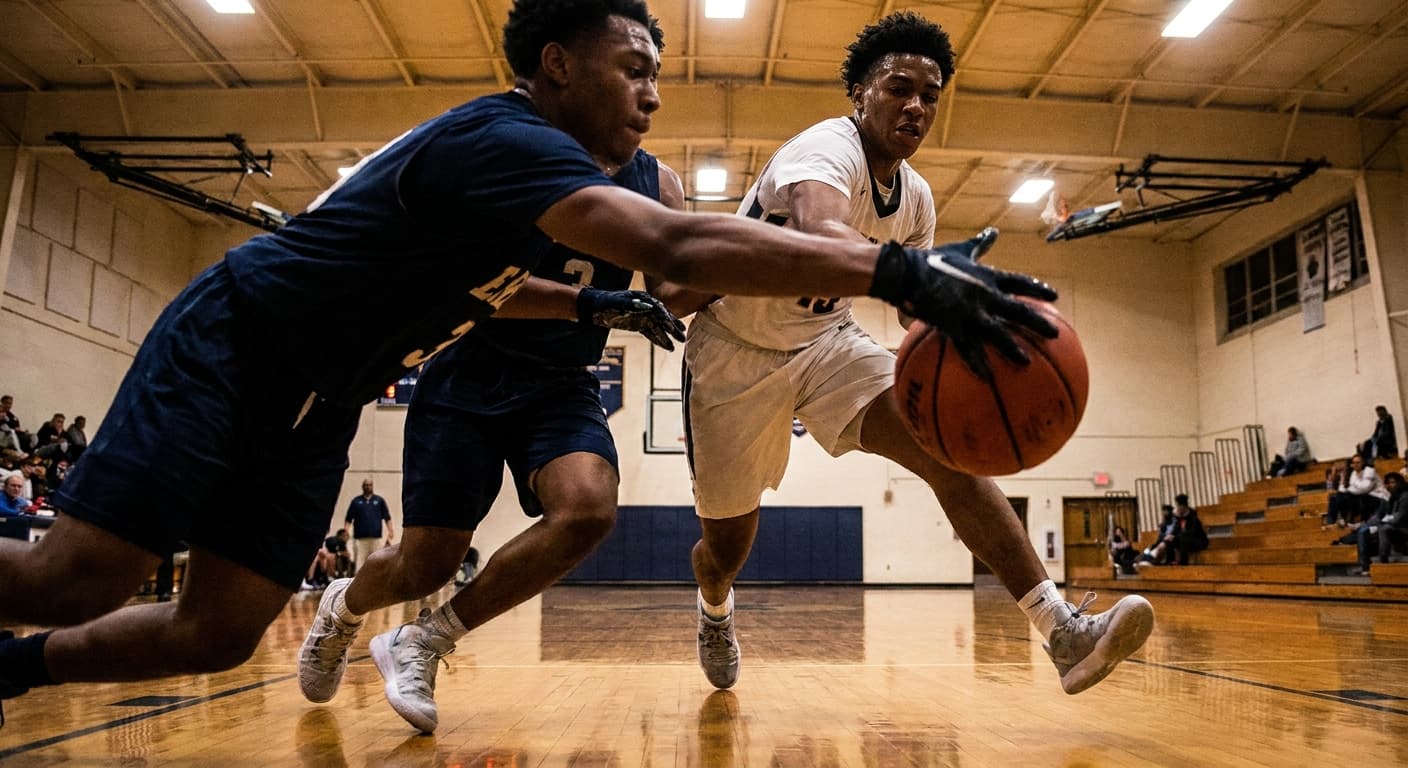
Reducing Turnovers in Basketball: 7 Concrete Techniques
The 3 turnover families and the solutions that actually work
A turnover costs your team roughly 1 to 1.1 points on average. It is a fully lost offensive possession, often followed by an opponent transition where defensive efficiency is also degraded. Multiply that by 3 or 4 pointless turnovers per game, and you have just handed the opponent a 4-point margin without them having to force anything.
Reducing turnovers is not about talent, it is about technique, game reading, and discipline. This guide covers the 3 main families of turnovers, 7 concrete techniques to reduce them with examples, and how to track your progress over time.
What exactly is a turnover
In basketball, a turnover (TOV in stats) is recorded each time you lose possession without a shot being taken. Exact rules vary by federation, but the three broad families are the same everywhere.
Family 1: active opponent turnovers
These are turnovers forced by the defense.
- Steal — opponent reads your pass and cuts it.
- Ball stripped — opponent takes the ball from your hands in a duel.
- Block-turned-possession — a blocked shot directly recovered by the opponent.
In these cases, the opponent did something well. You can reduce these by improving ball protection, but never eliminate them.
Family 2: self-inflicted offensive turnovers
Turnovers without direct defensive intervention.
- Travel — two consecutive steps without a dribble.
- Double dribble — restarting a dribble after a stop.
- Backcourt violation — ball returning to the defensive half after crossing.
- 3 seconds in the paint — a player stays too long in the restricted area.
- Offensive foul — charge on a set defender.
These turnovers are 100% avoidable. They come down to technique and discipline, not the opponent's talent.
Family 3: passing turnovers
- Mis-timed pass — your pass hits the feet, behind, or too hard.
- Pass read by defense — technically correct pass but anticipated by the opponent.
- Out-of-bounds pass — your pass goes straight out.
This is where game reading makes the biggest difference. A good passer avoids interceptions because they read the defense and pick the right pass at the right moment.
For an overall view of stats and where turnovers sit in the offensive equation, read the complete basketball stats guide.
Technique 1: the weak hand
The number one cause of dribble turnovers among amateurs is over-reliance on the strong hand. As soon as the defense pressures your dominant side, you have to be able to switch hands cleanly without slowing or looking at the ball.
Concrete example: a defender closes your drive line to the right. If you cannot dribble left-handed under pressure, you will:
- Either force a risky lateral pass.
- Or slow your dribble down while staring at the floor.
- Or travel while trying to change pivot foot.
Corrective drill: 15 minutes of left-hand dribbling at practice, 3 times a week, full-court up and back. No right hand during those 15 minutes. After 8 weeks, your weak hand will be at 80% of your strong hand.
Technique 2: pivot foot discipline
Traveling is the most frequent violation, especially after a rebound or a reception in traffic. It almost always comes from poor pivot-foot management.
Technical rule: when you receive or stop, your pivot foot is the first one to hit the floor on a jump stop, or the first foot to land on a two-step stop. You can pivot around it, but you cannot lift it before dribbling or shooting.
Concrete example: you grab a defensive rebound. Left foot lands first, right foot second. Your pivot is the left. You can lift the right to pivot, but if you lift the left without dribbling, it is a travel.
Corrective drill: reception + 180° pivot + pass, 20 reps per session, consciously tracking your pivot foot. Film yourself if possible — traveling is often invisible to the player committing it.
Technique 3: the two-hand pass
One-handed passes (one-hand push, baseball pass) look flashy, but they are far harder to control. Among amateurs and youth, they are the main cause of out-of-bounds passes and interceptions.
The simple rule: unless in a very specific context (open-court fast break, long cross-court pass), favor the two-handed chest pass. More accurate, easier to correct mid-flight, harder to intercept.
Concrete example: a guard grabs a defensive rebound and wants to start a fast break. He throws a 60-foot baseball pass to the point guard. The pass sails too high and goes out. Instead, a secure pass to the halfcourt line followed by a normal relay would have avoided the turnover.
Technique 4: triple threat before passing
"Triple threat" is the stance where you have the ball, feet planted, and all three options available: shoot, pass, dribble. The defense does not know what you will do, they have to cover all three simultaneously.
Most intercepted passes come from too fast a transition between catch and pass. You catch, you want to pass instantly, the defense anticipates because they saw your intent.
Concrete example: you catch on the wing and want to pass to the big in the paint. If you pass instantly, the help defender reads and cuts it. If you hold 1 second of triple threat (pivot foot planted, ball in the "pocket"), you force the help to choose: they stay on the big, you shoot; they come at you, you pass into the empty space.
One second of triple threat can add 0.1 to 0.2 points per possession in advanced stats. Over a game, that is huge.
Technique 5: read the defense before receiving
The best passers do not decide their pass after receiving. They decide it before. While the ball is in flight, they are already scanning the defense to see who is mismatched, who is coming in help, which teammate is one step ahead.
Concrete example: Nick Calathes in EuroLeague reads the defense 1 to 2 seconds before receiving. When the ball hits his hands, the decision is already made. Result: his passes leave without hesitation and find teammates in spaces the defense has not had time to close.
Corrective drill: before each reception, force yourself to mentally name "who is open left, who is open right, is there a help to cut." At first it is heavy, after 20 games it becomes automatic.
Technique 6: protect the ball on the dribble
A high dribble, arm extended, ball exposed, is an invitation to a steal. Ball protection on the dribble is a set of micro-techniques:
- Low dribble — under pressure, the ball never rises above the knee.
- Free arm as shield — the non-dribbling arm protects between ball and defender.
- Body between ball and defender — you always position so the ball is on the opposite side of the defender.
Concrete example: a point guard is pressed in the halfcourt. Instead of dribbling in front at waist height, he moves the ball to the hand furthest from the defender, lowers his dribble, and turns his shoulder to shield. The defender has no clean angle to attack the ball.
Technique 7: say "no" to the forced pass
The seventh technique is mental, not physical. It is also the hardest to apply in game situations.
The principle: if you do not have an obvious pass within 2 seconds of your decision, reset the possession. Kick it back to the point guard, re-run a set, let a screen set up. Never force a pass "because the play called for it" or "because the coach is watching."
Concrete example: a power forward catches at the low post, defense doubles. He sees a teammate far in the 45° corner, sends the pass "to show he made the right read," but the flight path crosses the double team. Turnover. The right decision was to kick the ball back out to the wing, reset, and find a cleaner entry 5 seconds later.
The turnover tracking pattern
To improve on turnovers, counting them is not enough. You need to classify each turnover by type to see where your real problems are.
Over 10 games, log each turnover into one of these 6 categories:
- Travel / double dribble — technical discipline.
- Intercepted pass — defensive reading.
- Out-of-bounds / errant pass — passing technique.
- Ball stripped on dribble — ball protection.
- Offensive foul — defensive positioning read.
- 3 seconds / backcourt — positional discipline.
After 10 games, a pattern emerges. For example: "of 32 turnovers, 18 are intercepted passes, 8 are travels, 6 are other." The message is clear: work first on reading the defense before passing.
This is the kind of diagnostic a rigorous tracking routine enables. To back it up, use the tools already available, notably the FG% calculator to cross-reference turnovers and shooting efficiency — a player who forces many passes often also has a weak TS%.
Benchmarks to remember
To situate your turnovers against level of play:
- Confirmed amateur point guard: 2.5 to 3.5 TOV per game.
- Semi-pro point guard: 2 to 2.8 TOV per game.
- European pro point guard: 2.2 to 3 TOV per game (higher volume).
- Wing / forward: 1.5 to 2.5 TOV per game.
- Big: 1.2 to 2 TOV per game (less ball handling).
If you are at the top of these ranges, the 7 techniques above will save you 0.5 to 1 turnover per game over an 8 to 12-week cycle. That sounds small. But over a 30-game season, it is 15 to 30 possessions recovered, meaning 15 to 30 potential points added to your net offensive contribution. At season scale, that is what moves a player from mid-pack to top of their league.
For a broader look at where turnovers sit among the stats that matter, the complete basketball stats guide puts the topic in context.
Turnovers are not inevitable. They are among the most reducible stats by conscious work — and probably the one that turns an "average" player into a "reliable" player fastest.
Frequently Asked Questions (FAQ)
How much does a turnover cost in points?
On average 1 to 1.1 points for your team. Over 30 games, 1 fewer turnover per game = ~30 extra points.
Which turnover type is the most avoidable?
Violations (travel, double dribble, 3 seconds, backcourt). 100% avoidable — pure technical discipline.
How to improve my weak hand?
Schedule 15 minutes of weak-hand dribbling, 3x a week. In 8 weeks, your weak hand reaches 80% of your strong hand.
What is the "triple threat"?
The stance where you hold the ball, feet planted, with all 3 options open: shoot, pass, dribble. 1 second of triple threat before the pass = fewer interceptions.
How long to see progress?
Count 8 to 12 weeks applying 2 or 3 techniques. Realistic target: -0.5 to -1 turnover per game.
Level up with HoopsTrackR
You now have all the keys. Let's be honest: logging stats by hand is tedious. HoopsTrackR does the math for you and shows your progress over time.
You might also like
Improve Your Free Throws: From 60% to 80% in 6 Weeks
The free throw is the only fully controllable shot in basketball. The BEEF method, a pre-shot routine, 4 drills and a 6-week program to go from 60% to 80%.
Beginner guide: how to start tracking your basketball stats
You want to track your basketball stats but don't know where to start? This beginner guide shows you what to measure, how often, which tools, and the mistakes to avoid.
Complete basketball stats guide: everything you need to know
The ultimate guide to understanding basketball statistics: points, rebounds, assists, shooting percentages and advanced stats. Everything you need to track your progress seriously.