
Basketball match sheet: 10 classic mistakes to avoid
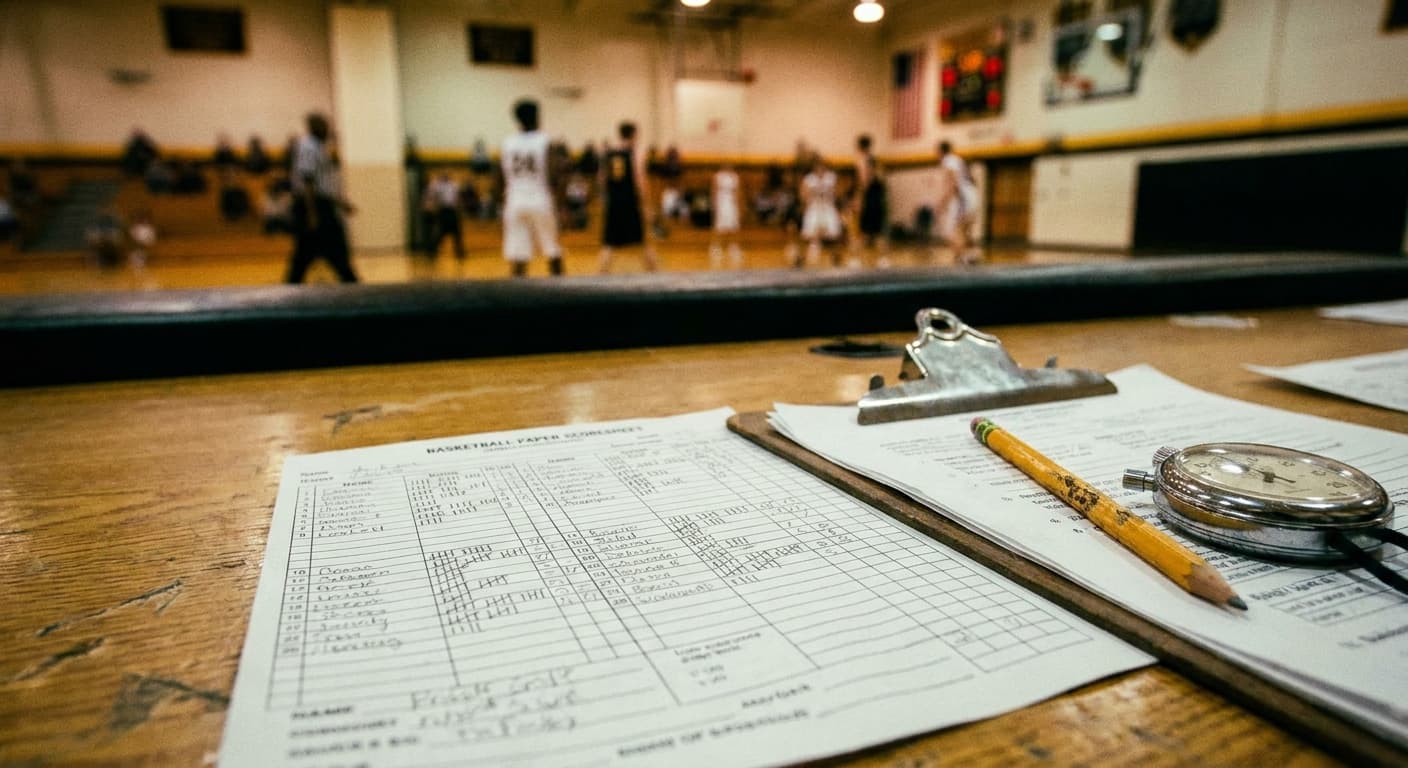
10 Mistakes to Avoid on a Basketball Match Sheet
Jersey numbers, fouls, timeouts, signatures — the full guide
The basketball match sheet is an official document. It records the score, fouls, timeouts, rostered players, minutes played — and it serves as proof in case of dispute. A poorly filled sheet can turn a game won on the floor into a game lost on a technicality, or trigger absurd disciplinary sanctions.
Whether you are a player-coach of an amateur team, a volunteer parent at the scorer's table, or a beginning official, here are the 10 most common errors on a basketball match sheet, with concrete scenarios and how to avoid them.
If you are looking for a tool to prepare and check your match sheets before tip, the match sheet generator produces a clean template ready to fill.
Mistake 1 — Wrong jersey number
This is the dumbest and most frequent error. A player changes jersey between two games (theirs got stained, they borrowed a bench player's), but nobody updated the match sheet. Result: every foul and every point they score is credited to another player.
Typical scenario: in a playoff game, the captain wears the 7 while the sheet lists him as the 5. He picks up his 5th foul in the 3rd quarter. Officials look for number 5 on the bench, who never stepped on the floor, and the foul is assigned to the wrong player. Dispute guaranteed at the end of the game.
How to avoid: before tip-off, the referee must visually confirm that each listed player wears the number written. This check takes 30 seconds and prevents 90% of disputes.
Mistake 2 — Miscounted fouls
Personal foul bookkeeping is critical: on the 5th foul, a player is ejected. Team foul bookkeeping triggers automatic free throws starting with the 5th team foul per period.
Typical scenario: a player picks up his 4th foul in the 2nd quarter. The scorekeeper forgets to tick. In the 3rd quarter, that same player commits what is really his 6th foul, but the sheet shows only 4. He stays on the floor until the opposing team requests a check and the error surfaces. At that moment, the game is in a legally awkward state.
How to avoid: on every foul whistle, the table must immediately call out "foul number X on player Y, team foul number Z." Vocal announcement forces immediate ticking and prevents lapses.
Mistake 3 — Missed timeouts
Each team has a limited number of timeouts per half (2 in the first half, 3 in the second half under FIBA rules). If a timeout goes unrecorded, a team can take more than allowed.
Typical scenario: coach A calls a timeout in the 1st quarter. The scorekeeper is focused on the previous foul and forgets to tick. Late in the game, coach A requests his 3rd second-half timeout and is refused because the sheet already shows 3 — when really it is his 2nd.
How to avoid: have a second table official dedicated to timeouts, or use a visual color code on the sheet (cross out in red on each timeout).
Mistake 4 — Miscounted minutes played
In leagues that require minutes tracking (notably youth categories with guaranteed minimum minutes), a minutes error can trigger a sanction.
Typical scenario: in U13, each player must play at least 10 minutes per game. A player plays 9 minutes 45, but the scorekeeper rounds up to 10 on the sheet. The opposing team, behind on the scoreboard, contests and requests video. The error is confirmed, administrative sanction follows.
How to avoid: use a dedicated stopwatch per player in youth categories, or a match sheet software that auto-computes.
Mistake 5 — Score mismatch
The score on the sheet must match the scoreboard at every quarter's end. A gap — even 2 points — is a major red flag.
Typical scenario: end of 2nd quarter, scoreboard shows 34–32, sheet shows 34–30. Who is right? You have to replay the sheet bucket by bucket to find the error, which takes 15 minutes and wrecks the 3rd quarter tip.
How to avoid: at each quarter's end, scorekeeper and scoreboard operator must announce their scores out loud. If both match, restart. If they diverge, correct before resuming play.
Mistake 6 — Ejected player back on the floor
A player ejected for 5 fouls or cumulative technical fouls cannot return. But if the sheet is poorly kept, a coach can mistakenly send him back.
Typical scenario: player 9 is out after his 5th foul. 3 minutes later, the coach, in the confusion of a line change, puts the 9 back in — who has not removed his jersey yet. Referees do not notice immediately. When the error surfaces, the game must be reviewed to decide whether a team-wide sanction applies.
How to avoid: physically, a player ejected for 5 fouls must remove his jersey or put on a vest. Administratively, the "ejected" checkbox on the sheet must be ticked prominently.
Mistake 7 — Match sheet unsigned before tip
The match sheet must be signed by both coaches and referees before tip, with the list of rostered players. Without that signature, an unrostered player cannot enter the floor.
Typical scenario: a player arrives late, at minute 5. The coach wants to put him in, but his name is not on the sheet. If the sheet has already been signed, the player legally cannot play, even though he is present. The team is down to 11 available players instead of 12 for the rest of the game.
How to avoid: roster all 12 players on the list ahead of time (even those who may arrive late), and cross them out if absent at warmup's end.
Mistake 8 — Substitute entering without notification
Every substitution must be reported to the scorer's table, which validates and releases the substitute on the referee's whistle. A player entering without notification triggers a technical foul on his team.
Typical scenario: in the rush of a close game ending, the coach sends his substitute straight from the bench to the floor without going through the table. The referee whistles technical foul, 1 free throw and possession to the opponent. A classic scenario of a game lost on administrative error.
How to avoid: enforce strict team discipline — always request through the table, wait for the signal, enter at the right moment.
Mistake 9 — Mismanaged free throws
A made free throw scores 1 point, a missed one does not. But the total of free throws attempted and made on the sheet must match the points actually scored from the line.
Typical scenario: a player takes 2 free throws and makes 1. The scorekeeper records 1 point, which is correct, but forgets to log the missed attempt. At game's end, "free throws attempted" is wrong, which skews the FT% in official stats.
How to avoid: on every free throw sequence, record "made" or "missed" distinctly for each attempt, not just the points scored.
Mistake 10 — Missing end-of-game signatures
At game's end, both coaches, referees, and table officials must sign the sheet to make it official. An unsigned sheet opens the door to later disputes.
Typical scenario: the game ends at 9:30 PM, players rush to leave, coaches walk away without signing. Two days later, the federation contacts the team to regularize. Without signature, the result is in limbo for 72 hours, and the opposing team can theoretically request a replay.
How to avoid: the end-of-game protocol must be ritualized — final buzzer, team handshake, signatures, equipment storage. In that order. No exit from the gym until the sheet is signed.
The 5-point checklist to keep on hand
If you are in charge of the match sheet, remember this minimal checklist:
- Before tip — jersey numbers confirmed, players rostered, sheet signed by coaches + referees.
- During the game — vocal announcement of each foul, separate tracking of timeouts, minutes followed for youth players.
- At each quarter's end — cross-check of score table + scoreboard.
- On ejection — "ejected" box ticked, player removes jersey, no return possible.
- End of game — complete signatures, copy sent to proper recipients.
To go further, our complete basketball stats guide explains the link between what is recorded on the match sheet and the stats that derive from it. And to generate a clean sheet to print before the game, use the match sheet online tool.
The match sheet is not a paperwork exercise. It is the written trace of the game, the one that holds authority before the federation. A well-kept sheet protects the team, the coach and the players. A poorly kept sheet can flip everything.
Frequently Asked Questions (FAQ)
Who is responsible for the match sheet?
The scorer's table, under referee supervision. Both coaches must sign before tip and at the end of the game.
What to do if an error is spotted during the game?
Report it immediately to the head referee. The longer you wait, the harder correction becomes.
Is an unsigned sheet valid?
No. Without coach and referee signatures, the result is pending and the opponent can contest.
How to handle a jersey number error?
The referee checks visually before tip. Any change must be logged in writing on the sheet before play resumes.
Is there an official template?
Yes, each federation provides its own. Use our match sheet generator to prepare a clean printable version.
Level up with HoopsTrackR
You now have all the keys. Let's be honest: logging stats by hand is tedious. HoopsTrackR does the math for you and shows your progress over time.
You might also like

How to measure your basketball progression over 12 months
How do you know if you're really improving at basketball over a full year? Baseline, monthly checkpoints, stats that prove progression, handling the plateau.

Point guard: the key stats to track
Which basketball stats really matter for a point guard? A/TO ratio, usage rate, PPG vs APG, FG%… The dedicated guide for the 1 position with NBA and EuroLeague examples.

How to Analyze Your Performance After a Basketball Game
Discover the complete method to analyze your performance after every game: the 5 essential questions to ask yourself, the 7 key stats to track, and how to turn your observations into a concrete improvement plan. Inspired by the best players and coaches.