
Improve Your Free Throws: From 60% to 80% in 6 Weeks
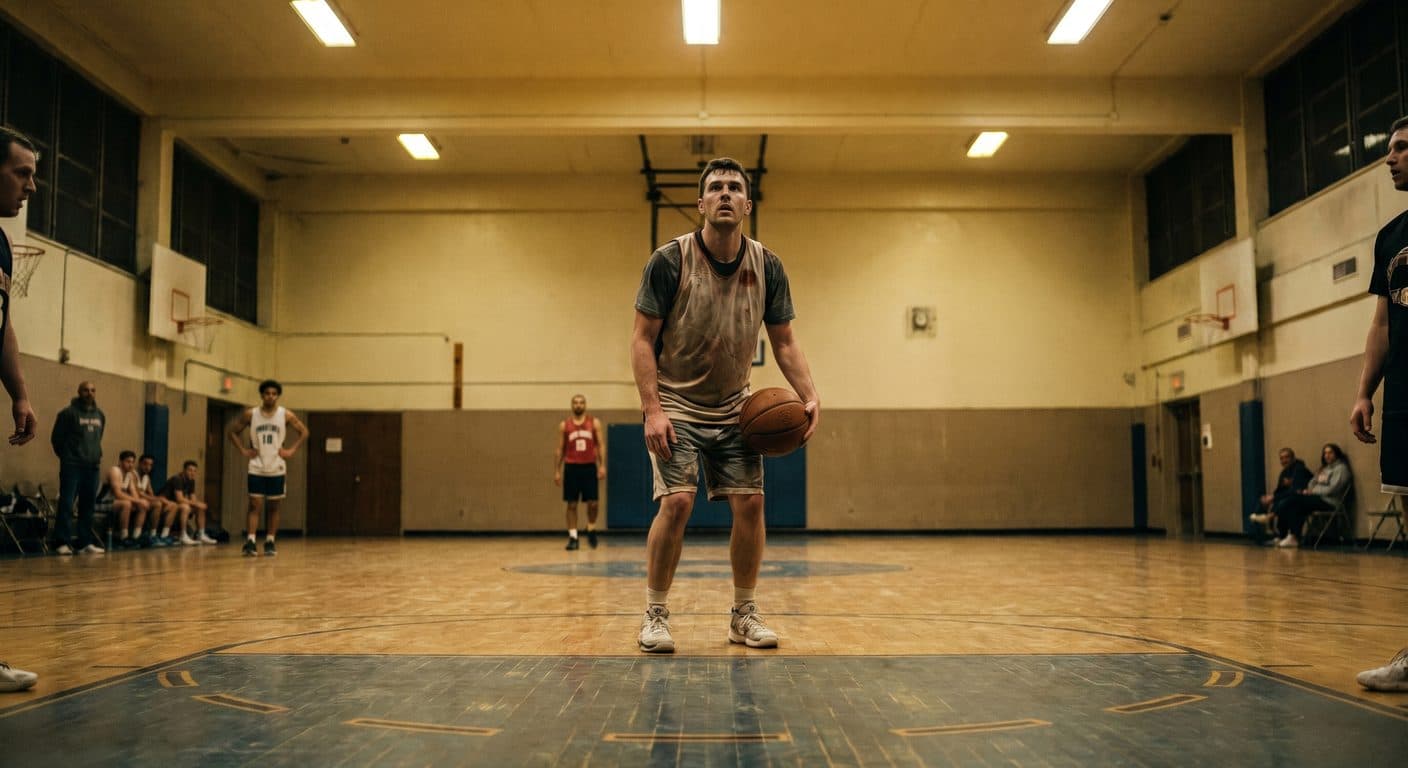
Free throws: go from 60% to 80% in 6 weeks
The BEEF method, the pre-shot routine and the program that make your free-throw line reliable
The free throw is the only shot in basketball with no defender, no clock, no excuse. Yet most amateurs cap out at 60% and end up losing close games at the line. The good news: it is also the fastest shot to fix. Six weeks of targeted work, fifteen minutes per session, are enough to go from 60% to 80%.
This guide breaks down the BEEF mechanics letter by letter, gives you the pre-shot routine of elite shooters, lists the 5 errors that stall your percentage, and lays out a week-by-week program to clear 80%. If you are new to tracking your shots, keep the complete basketball stats guide close.
Why most amateurs cap out at 60%
Free throws don't improve by shooting more. They improve by shooting better.
Most amateur players repeat the same flawed mechanics hundreds of times. The result: the brain locks in the wrong pattern, and every rep reinforces the error instead of fixing it.
Technique first, volume second: that's the order 80% of players reverse. They fire 100 shots with no reference point, convinced quantity will eventually pay off. It never does without intention.
A missed free throw costs a sure point — one you had already earned by drawing the foul. Over a 30-game season, going from 60% to 80% on 6 attempts per game recovers roughly 36 points. Enough to flip several close finishes.
Quick win: the 10 conscious free throws rule
Before your next session, shoot 10 free throws with one single focus: finish every shot with your hand in the goose neck position — fingers pointing down, wrist snapped forward.
Think about nothing else. Not the result, not the score, just the wrist finish. This one cue improves shot arc for most players who apply it from the very first session.
Why it works: the goose neck forces a consistent backspin and a higher release angle. Two of three balls that hit the rim drop when the arc is right, versus one of three on a flat shot.
The BEEF method, broken down letter by letter
BEEF is the best-known free-throw acronym in basketball. Four checkpoints, in this exact order:
| Letter | Element | Key point |
|---|---|---|
| B — Balance | Stance | Feet aligned with the basket, shoulder-width apart, weight on the balls of the feet |
| E — Eyes | Focus | Lock on the front of the rim, not the center, and hold the gaze to the finish |
| E — Elbow | Arm | Elbow under the ball, aligned with the basket, forming an L |
| F — Follow-through | Finish | Hand in goose neck, held 2 seconds after release |
Work each letter in order. If your balance is off, your elbow drifts, and no wrist fix will save the shot. Fix BEEF in sequence, never in parallel.
1. Balance — it starts from the feet
Set your strong foot slightly ahead, toes pointed at the basket. Weight sits on the balls of the feet, never the heels. A shot that drifts backward almost always comes from sitting on the heels.
2. Eyes — a point, not a zone
Pick a precise target: the front of the rim or a hook of the net. The brain aims better at a sharp target than a wide one. Keep your eyes there through the whole motion.
3. Elbow — alignment before power
The elbow stays under the ball and on axis. If it kicks outward, the ball drifts left or right. Check the angle: forearm vertical at the set point.
4. Follow-through — the motion continues past the ball
The shot doesn't end when the ball leaves. The hand finishes high, wrist relaxed, fingers toward the floor. Hold it 2 seconds: it's the best sign your mechanics are complete.
The pre-shot routine: your anchor under pressure
Steph Curry takes 3 dribbles, looks at the basket, spins the ball, then shoots. Every time. No exceptions, regular season or finals.
This ritual brings your brain back to the same state before every attempt. In a game, pressure rises and changes your breathing, your tempo, your muscle tension. A fixed routine cancels those swings and returns you to your trained motion.
Build yours in 4 to 6 seconds max:
- Dribbles — 2 to 3 identical dribbles to center yourself and start the timing.
- Breath — one short exhale that drops the shoulders.
- Eyes — locked on your target point.
- Shoot — trigger without hesitation, same tempo as in practice.
Replicate it exactly in practice and in games. Players who miss under pressure almost always run a different routine in competition.
Arc, backspin and entry angle
A free throw that drops consistently has three physical signatures: a high arc, steady backspin, and an entry angle close to vertical.
Arc: aim for a trajectory peak that clears the rim well. A flat arc gives the ball only a thin band of rim to drop through. A high arc widens the entry window.
Backspin: backward rotation softens contact with the rim. A ball spinning well that hits the front of the rim tends to roll inward. A ball with no spin bounces anywhere.
Entry angle: the best shooters send the ball in at around 45 degrees. You don't have to measure it — just aim "over an imaginary wall 2 meters in front of you" and the arc sets itself.
The 5 technical errors a stalled percentage reveals
When your percentage stalls, the culprit is almost always on this list:
- Flat arc — the ball enters the front of the rim and bounces out. Shoot over the imaginary wall 2 meters out.
- Misaligned foot — your body is off axis. Line up foot, knee, shoulder and elbow toward the basket.
- Cut follow-through — you stop the motion too early. Hold the goose neck 2 seconds.
- Aiming at the back rim — target the front of the rim, never the back.
- Inconsistent routine — changing your dribbles or timing creates mental instability.
Film yourself from the front, then from the side, over 10 shots. The camera spots in 30 seconds what you can't feel in the motion.
4 drills to go from 60% to 80%
Each drill targets a layer of the problem, from pure mechanics to game pressure:
| Drill | Goal | Reps / session | Starting |
|---|---|---|---|
| Shot from 50 cm out | Lock in BEEF without power | 20 shots | Week 1 |
| Free throws in sets of 10 | Automate the motion | 50 shots | Week 2 |
| Free throws under fatigue (after 30 s sprint) | Resist physical fatigue | 20 shots | Week 3 |
| Game simulation (verbal pressure, 5 s to shoot) | Mental management | 30 shots | Week 5 |
Progression rule: don't move to the fatigue drill before you hit 70% in normal conditions. Skipping steps just locks in rushing.
The week-by-week program
Six weeks, three sessions per week minimum. Each phase has a numeric target:
| Week | Focus | Target % | Reps / session |
|---|---|---|---|
| 1 to 2 | BEEF mechanics + fixed routine | 65% | 40 shots |
| 3 to 4 | Automation + volume | 72% | 60 shots |
| 5 to 6 | Pressure + game simulation | 80% | 50 shots (+ fatigue) |
Progress is not linear. You may regress in week 4 before jumping in week 5: that's the sign the motion is reorganizing. Don't switch methods at the first plateau.
Shooting late in games: fatigue and pressure
Your legs give out before your arms. As fatigue rises, the shot starts from the shoulders instead of the legs, and the arc collapses.
That's why the post-sprint drill matters so much. You train your motion to stay clean when your cardio is in the red — exactly the conditions of the last 2 minutes of a close game.
At the line late in a game, return to your routine and your breath. One slow exhale before the shot lowers your heart rate and steadies your hands.
What your free-throw percentage reveals about your game
The raw number doesn't tell the whole story. The context of your misses often says more.
- Misses clustered late — fatigue or pressure management, not mechanics.
- Miss on the first of a pair — rushed routine, you weren't centered yet.
- Percentage drops on the road — the environment rattles you, work your concentration tunnel.
Log your percentage and the context of each miss for 4 games. The pattern shows up fast. A tracking app like HoopsTrackR can help you log your free-throw percentage game by game and verify whether your practice gains hold up in competition.
Benchmarks: what percentage makes you good?
Place yourself against these thresholds, valid from amateur level to elite:
| Percentage | Level | Read |
|---|---|---|
| < 60% | Fix it | Unstable mechanics or routine, top priority |
| 60 to 70% | Improving | The motion is there, conscious volume is missing |
| 70 to 80% | Decent | Reliable without pressure, needs game-proofing |
| 80 to 90% | Good | A real asset, you draw fouls without fear |
| 90%+ | Elite | A late-game weapon at any level |
Useful reference: NBA teams average around 77 to 78%. Hitting 80% as an amateur already means shooting better than the pro average on this exact shot.
Frequently asked questions (FAQ)
How many free throws per session to actually improve?
40 to 60 conscious shots per session, 3 times a week. Under 30, progress is too slow. Over 80, quality drops from mental fatigue.
Does physical strength affect free-throw shooting?
Very little. The free throw is 85% technique and mental. With the right mechanics, a light player can shoot 90%. Work technique before chasing power.
Should I always shoot from the same spot?
Yes, always exactly at the center of the line. A 4-inch offset changes the angle to the basket. Repeatability is the key to your percentage.
How do I hold my percentage under game pressure?
Your pre-shot routine is your anchor. The more faithfully you replicate it in practice, the more it holds in games. Add a slow exhale before the shot to steady your hands.
What percentage makes you a good free-throw shooter?
70% is the decent threshold for a competitive amateur, 80% is good, and 90%+ is elite at any level. NBA teams average 77 to 78%.
To place your shot in the bigger picture of your progress, head back to the complete basketball stats guide and to calculating your field goal percentage. To track your percentages, the FG% calculator tool does the math for you.
Your free throw isn't a shot of luck. It's the only shot you can repeat endlessly with no defender — the most honest version of your discipline.
Passe au niveau supérieur avec HoopsTrackR
Tu as maintenant toutes les clés. Soyons honnêtes : noter ses stats à la main, c'est fastidieux. HoopsTrackR fait le calcul pour toi et te montre ta progression sur la durée.
Vous aimerez aussi
How to Reduce Basketball Turnovers with Stats Tracking
Every turnover costs about 1 point. Learn to measure your turnovers by type, turnover rate and A/TO ratio to target the real cause.
Offensive rebounding in basketball: score 8 extra points per game from second chances
Teams that crash the glass score 8 extra points per game in second chances. OREB%, 3 core techniques, 4 drills and a 4-week program to become a reliable offensive rebounder.
How to Analyze Your Performance After a Basketball Game
Discover the complete method to analyze your performance after every game: the 5 essential questions to ask yourself, the 7 key stats to track, and how to turn your observations into a concrete improvement plan. Inspired by the best players and coaches.