
How to calculate Field Goal Percentage (FG%) in basketball
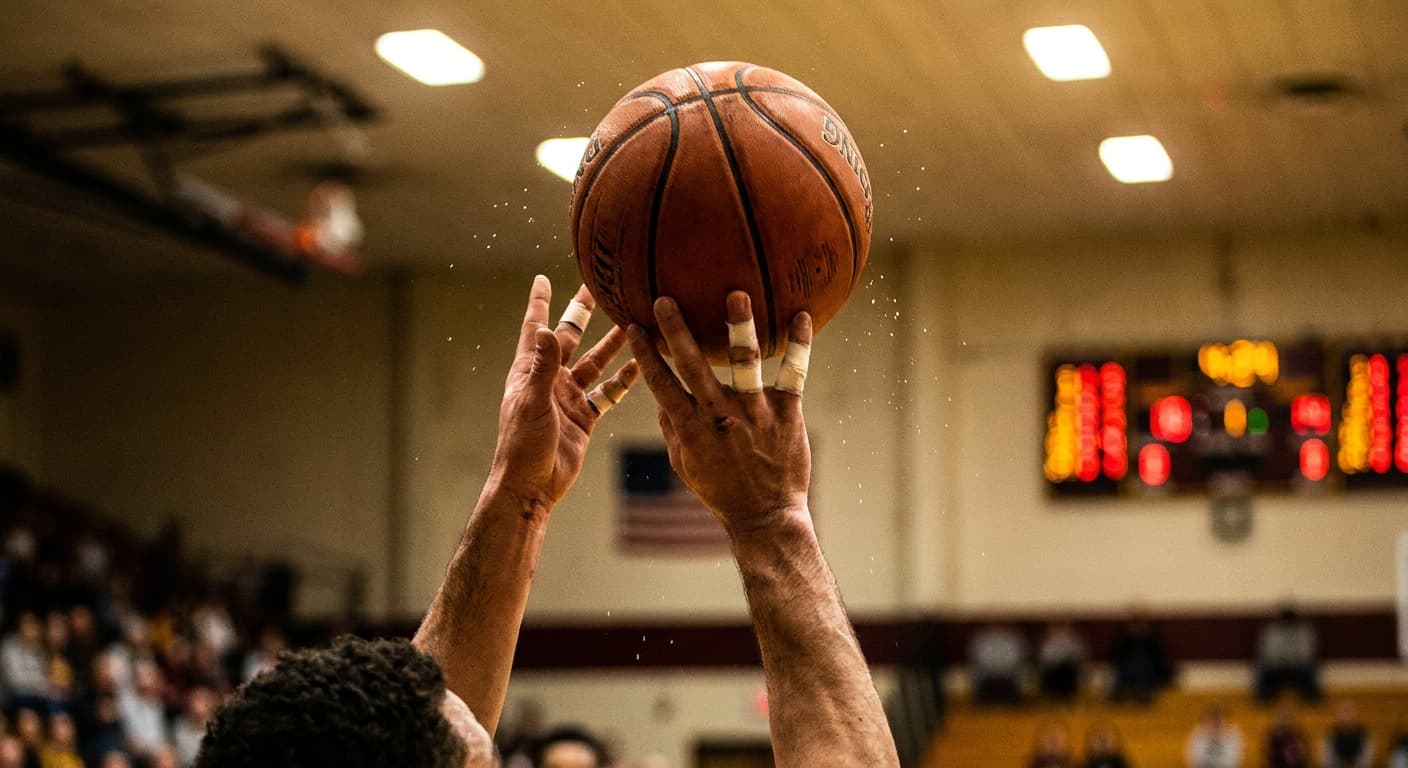
How to Calculate Field Goal Percentage (FG%)
The formula, worked examples, and benchmarks to place yourself
Field Goal Percentage, or FG%, is probably the first stat you need to master when you start analyzing your game. It is the most direct answer to the question "when I shoot, do I score?". This article is part of our complete basketball stats guide, where you can go back to see how FG% fits among the other stats.
What Field Goal Percentage means
Field Goal Percentage is the percentage of made shots out of total shot attempts, at all distances, except free throws. It includes both two-pointers and three-pointers, but it excludes the free-throw line.
In English box scores you will see the FG% column next to FGM (Field Goals Made) and FGA (Field Goals Attempted). The shorthand is universal.
The exact formula
The formula is elementary:
FG% = (Field Goals Made / Field Goals Attempted) × 100
Where:
- Field Goals Made (FGM): all made shots from the field (2-pointers and 3-pointers).
- Field Goals Attempted (FGA): every shot attempt from the field, made or missed. A blocked shot counts as an attempt.
Free throws are not part of the equation. If you go 10-for-15 from the floor and 6-for-8 at the line, your FG% is 10/15 = 66.7%, regardless of your free-throw percentage.
A worked example on a single game
Take a concrete game. Your box score looks like this:
- 4 made two-pointers out of 9 attempts
- 3 made three-pointers out of 7 attempts
- 5 made free throws out of 6 attempts
To compute FG%, you combine the two-pointers and the three-pointers:
- FGM = 4 + 3 = 7
- FGA = 9 + 7 = 16
- FG% = 7 / 16 = 0.4375, so 43.75%
The 5-for-6 free throws are excluded: those belong to FT% (Free Throw Percentage), not FG%.
A worked example over a season
Now imagine a 22-game season. You took 264 shots and made 122.
- FG% = 122 / 264 = 0.462, so 46.2%
That is a perfectly respectable FG% for an amateur perimeter player. Whether it is "good" in your specific case depends on your position and style.
What is a good FG%?
The answer varies heavily by position. Here are realistic ranges for a confirmed amateur player (regional or state-level league, men's game):
| Position | Decent FG% | Strong FG% | Amateur elite |
|---|---|---|---|
| Point guard | 42% | 47% | 52%+ |
| Shooting guard | 43% | 48% | 53%+ |
| Small forward | 45% | 50% | 55%+ |
| Power forward | 48% | 53% | 58%+ |
| Center | 52% | 58% | 63%+ |
Why the differences? Because a center plays mostly near the rim, on 3-to-6-foot shots, so his expected FG% is mechanically higher. A point guard who shoots threes will have a lower FG%, but each three is worth 50% more, so a decent 3P% makes up for it.
Watch out: raw FG% ignores that nuance. A point guard at 40% who takes many threes can be more efficient than a wing at 48% who only takes twos. That is exactly what True Shooting Percentage corrects — more on that below.
What drives your FG%
Four major factors drive your FG%:
1. Shot selection
Taking the right shots at the right time is 80% of the job. A player who forces three contested shots in the last minute drags his FG% down for nothing. A patient player who waits for a switch, moves the ball, and takes his open shot naturally sees his percentage rise.
The five-second rule is useful: if after five seconds of action you do not have an open shot or a clear advantage, pass the ball and restart.
2. Shot distance
Statistically, the highest-value shots are:
- Layups and dunks: 65-80% expected success rate.
- Corner threes: 37-42% expected (no depth correction).
- Top-of-the-key threes: 33-38% expected.
- Mid-range jumpers: 38-45% expected but only worth 2 points.
Mid-range jumpers are mathematically the least efficient shot: as hard as a three, worth less. Unless you are a specialist (think Chris Paul or DeMar DeRozan), the mid-range should stay the exception.
3. Fatigue
Your fourth-quarter FG% is almost always lower than your first-quarter FG%. Fatigue reduces leg drive, and therefore accuracy. Improving your cardio directly improves your FG% over the duration of a game.
4. Opposing defense
A serious defender — close, tall, active — can drop a FG% by 10 points. That is why advanced trackers separate "contested vs uncontested" attempts when they can. If your FG% collapses against teams that defend hard, the fix is not to change your shot, it is to get open better.
How to improve your FG%
Three concrete levers:
Lever 1 — A daily shooting routine
The best amateur shooters take 200 to 500 shots per day, not in games, not in pickup, just in shoot-around. The goal: build an automatic mechanic that holds under pressure.
An effective routine: 50 shots at 10 feet, 50 at 13 feet, 50 at 17 feet, 50 at 20 feet, 100 free throws. Timed, logged in a notebook or an app. Regularity is what you measure, and measuring is how you build it.
Lever 2 — Conscious shot selection
Before a game, set yourself a rule: "I only take corner threes and drives." Play the game that way. Check your FG% in the evening. You will often be pleasantly surprised.
Lever 3 — Statistical tracking
You do not improve what you do not measure. Use an app like HoopsTrackR to track your FG% by zone, by opponent, by period. After 10 games, you will have data you can act on.
FG% vs. True Shooting %
FG% has a limit: it treats a three-pointer like a two-pointer. But a three is worth 50% more. That is why analysts invented True Shooting Percentage (TS%), which weights the different shot types properly. We detail it with the full formula in our article Advanced basketball stats explained simply.
In short, if you want a single efficiency stat, look at TS%. If you want to know whether your field shots are going in, look at FG%. The two are complementary.
Common mistakes in computing FG%
A few classic traps to avoid:
- Including free throws — no, only 2-pointers and 3-pointers count.
- Excluding blocked shots — a blocked shot counts as an attempt and a miss.
- Forgetting missed and-ones — if you score through contact and miss the bonus free throw, the made 2-pointer counts in your FG%, but the missed free throw does not.
- Counting the opponent's makes — obvious in principle, but a classic mistake when you first start keeping a paper scorebook.
Tools to track your FG%
Three options:
- The paper scorebook — classic, but you have to recompute at the end. Simple and reliable.
- A spreadsheet in Excel or Google Sheets — you create a FGM and FGA column per game, the formula handles the rest.
- A dedicated app like HoopsTrackR — fast input during the game, automatic calculation, visualizations by zone and by period. The recommended option if you play more than 15 games per season.
Summary
Field Goal Percentage is your offensive compass. The formula is simple: made field goals divided by field goal attempts. What is hard is:
- Measuring it honestly, game after game.
- Comparing it to the expected level for your position.
- Identifying the zones where you lose points and working on them.
To put FG% back in the broader landscape of basketball statistics, go back to the complete basketball stats guide. And to go beyond, dive into advanced stats, which explain why FG% does not tell the full story.
A good FG% is not a vanity number. It is the sign that you take the right shots at the right times, which is literally the definition of a good offensive player. Work on it, measure it, compare it. That is what separates players who think they shoot well from players who actually do.
Frequently Asked Questions (FAQ)
Do free throws count in FG%?
No. FG% only includes field goals (2- and 3-pointers). Free throws are tracked separately through FT%.
What is a good FG% for an amateur player?
A solid threshold is around 45% for a perimeter player and 55%+ for an interior player. Real benchmarks depend on your position (see the table above).
Does a blocked shot count as an attempt?
Yes. A blocked shot counts as an attempt and a miss. It lowers your FG%.
How can I improve my FG% quickly?
Three levers: daily shooting routine, conscious shot selection, and stat tracking to identify the zones to work on.
FG% or TS% — which to prioritize?
Both are complementary. FG% tells you if your field shots are falling. TS% gives overall efficiency including threes and free throws.
Level up with HoopsTrackR
You now have all the keys. Let's be honest: logging stats by hand is tedious. HoopsTrackR does the math for you and shows your progress over time.
You might also like
Understanding Plus/Minus (+/-) in basketball: the impact stat
Plus/Minus (+/-) is the stat that measures the score differential while a player is on the floor. Here is how it is calculated, how to interpret it, and why it has limits.
Complete basketball stats guide: everything you need to know
The ultimate guide to understanding basketball statistics: points, rebounds, assists, shooting percentages and advanced stats. Everything you need to track your progress seriously.
How to Reduce Basketball Turnovers with Stats Tracking
Every turnover costs about 1 point. Learn to measure your turnovers by type, turnover rate and A/TO ratio to target the real cause.